Unsure about surgery? Get a trusted second opinion within 24-48 hours from the top orthopedic surgeons in the country.

Is It Actually Time for
Knee Replacement?
The 5 clinical signs surgeons use to recommend surgery — and the gray areas most patients never hear about.
By the XPRT2ND Medical Review Team · 8 min read · Board-Certified Reviewed
790K
knee replacements
performed annually in the u.s.
1 in 3
patients report
doubt before surgery
34%
of knee replacements
may be premature*
24-48h
time to recieve your
independent review
*Serving patients across Phoenix, Scottsdale, Tucson, and the greater Arizona area
If you've recently been told you're "bone-on-bone" and it's time for surgery — you're about to make one of the most permanent decisions of your life. The question isn't just whether your knee is bad. It's whether right now is the right time, and whether the recommendation you received is the complete picture.
Most orthopedic consults last under 15 minutes. You walk in with pain and an X-ray, and you walk out with a surgical recommendation. That's not negligence — it's the reality of a strained healthcare system.
But a knee replacement is not a cortisone shot. It is not a reversible procedure. And the decision to operate — or to wait — has compounding consequences that can follow you for the next 20 years.
In this guide, we'll walk through the five clinical thresholds surgeons use to recommend knee replacement, the gray zones most patients never hear about, and the one step that consistently gives patients the clarity they need before making this call.
In Arizona specifically, where orthopedic surgical volumes have grown significantly with the state's aging retiree population, the pressure to schedule quickly is real. Many patients in the Phoenix metro and Tucson corridors report consults lasting under 10 minutes before a recommendation was made.
1
SIGN ONE
Your Daily Life Has Shrunk
Pain is subjective. Functional limitation is measurable. Orthopedic surgeons don't just operate because your knee hurts — they operate because your knee has stopped letting you live.
The clinical threshold is called "functional impairment," and it's measured by asking very specific questions:
Can you walk more than two city blocks without stopping?
Have you stopped using stairs or given up activities you enjoyed?
Does knee pain wake you from sleep on most nights?
Have structured PT, injections, and weight optimization genuinely failed?
If your world is genuinely shrinking and conservative care has been exhausted, surgery becomes clinically reasonable. But if you haven't worked through structured conservative treatment — or only gave it a few weeks — you may be moving too fast.
Not sure if you've hit the real threshold?
Get your imaging and history reviewed by an independent orthopedic specialist — not the one who benefits from the surgery.
2
SIGN TWO
The "Bone-on-Bone" Diagnosis
This is the phrase patients hear most — and the one they understand least.
"Bone-on-bone" sounds like an absolute verdict. But it's often more nuanced than the phrase suggests. True bone-on-bone means the articular cartilage — the shock-absorbing surface inside your joint — is completely gone in the affected compartment.
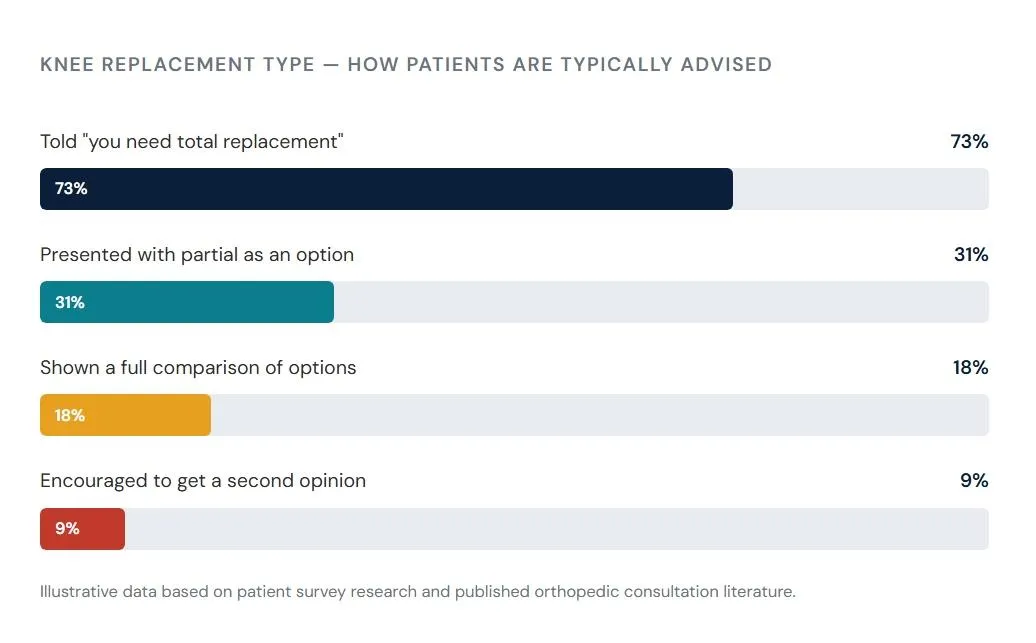
Here's what many patients are never told: the knee has three compartments. If only one is severely worn, you may qualify for a partial (unicompartmental) knee replacement rather than a total replacement. The difference in recovery is dramatic.

If no one has explicitly explained which compartment is worn and why that means you need a total replacement — that's a gap worth closing before you consent.
3
SIGN THREE
The Timing Trap — Especially If You're Under 60
Modern knee implants last between 15 and 20 years — and that number is improving. If you're 52 years old and you operate today, there's a realistic chance you'll need a revision surgery in your early 70s.
What is Revision Surgery?
A revision knee replacement is a second surgery to replace a worn-out or failing implant. Compared to the primary procedure, revisions are:
Significantly more complex due to scar tissue and bone loss
Associated with longer recovery times and higher complication rates
Performed at a time when you may have less recovery capacity
More expensive and more difficult to achieve optimal outcomes
This doesn't mean you should suffer through another decade of pain to avoid revision. But it does mean the "when" of surgery is as important as the "whether."
The strategic balance — waiting long enough to reduce revision risk, but not so long that you lose your best recovery years — requires the kind of nuanced conversation that a 10-minute consult rarely provides.
4
SIGN FOUR
The Robotic Surgery Question
You've likely seen advertisements for robotic-assisted knee replacement. The technology — platforms like Mako, ROSA, and Navio — can offer meaningful precision advantages in the right hands and the right cases.
But here is the reality that marketing rarely says clearly:
"The robot does not replace surgical judgment. It is a tool — and it is only as good as the surgeon who programs it and operates it. In some practices, it's a genuine clinical asset. In others, it's a premium price point with modest additional benefit."
XPRT2ND Medical Review Board
What matters more than the technology is the surgeon's case volume, their complication rates for your specific procedure, their implant selection philosophy, and whether the robotic approach is genuinely indicated for your anatomy — or simply what that facility markets.
Was the conversation more about technology than your anatomy?
An independent specialist can review your surgical plan and tell you if the approach is appropriate for your specific case.
5
SIGN FIVE
Red Flags of a Rushed Recommendation
Not all orthopedic consults are equal. High-volume, procedure-driven practices move quickly. Good surgeons exist inside those systems — but the structural pressure to schedule creates environments where important conversations get cut short.
Pay attention if you experienced any of the following during your consult:
The appointment lasted under 10 minutes before a surgical recommendation was made
Your most recent MRI was not reviewed — only an older X-ray
Risks including blood clots, infection, stiffness, or implant failure were not discussed in detail
Alternative treatments or the option to delay were not genuinely explored
You felt subtle or direct pressure to "book now" to secure a date
Your questions were minimized or met with impatience
Here's the Problem Nobody Says Out Loud
When you ask the surgeon who would perform your operation whether you need the operation, you are asking someone who benefits — financially and professionally — from that decision.
That's not an accusation. Surgeons are trained to believe in surgery. Most of the time, they're right. But structural incentives exist, and they do influence recommendations at the margins.
Independent confirmation doesn't mean your surgeon is wrong. It means you have a neutral third party with nothing to gain or lose from your decision — reviewing your imaging, your history, and your surgical plan and giving you a clear, written answer.
Most patients who receive that confirmation feel the same thing: the anxiety disappears.
"I was scheduled for total knee replacement in three weeks. Something felt off — the whole consult took maybe twelve minutes. I submitted my case to XPRT2ND on a Tuesday and had my written review by Thursday. The specialist confirmed surgery was appropriate, but also flagged that I might be a better candidate for partial replacement given my imaging. That conversation alone changed my outcome."
Michael R.
Age 58, Arizona · XPRT2ND Patient
What matters more than the technology is the surgeon's case volume, their complication rates for your specific procedure, their implant selection philosophy, and whether the robotic approach is genuinely indicated for your anatomy — or simply what that facility markets.
Was the conversation more about technology than your anatomy?
An independent specialist can review your surgical plan and tell you if the approach is appropriate for your specific case.
How XPRT2ND Works
We built XPRT2ND for exactly this moment — after you've received a recommendation, before you've committed to surgery.

Step 1 — Submit Your Case (15 minutes)
Upload your imaging (X-rays, MRI), your medical history, and the surgical recommendation you received. Our secure platform handles HIPAA-compliant file transfer.

Step 2 — Independent Expert Review
A board-certified orthopedic specialist — with no affiliation to your current provider and no financial stake in your decision — reviews your complete case.

Step 3 — Written Clarity in 24–48 Hours
A board-certified orthopedic specialist — with no affiliation to your current provider and no financial stake in your decision — reviews your complete case.

Step 4 — Walk Into Your Decision With Confidence
Whether the answer confirms surgery or reveals alternatives, you now have independent expert validation. Doubt is replaced by certainty.
Don't Walk
Into Surgery
With Doubts.
You already have the imaging. You already have the diagnosis. All you need now is a neutral, expert second set of eyes — with no skin in the game — to confirm you're making the right call.
Secure
HIPAA-Compliant
Upload
Board-Certified
Orthopedic Expert
Written
Review in
24–48 Hours
No Surgical
Incentive. Ever.
No referral needed · Reviewed by a board-certified orthopedic specialist · Results in 24–48 hours
Our 48-Hour Review Guarantee
If you do not receive a thorough, professional written review within 48 hours of your case being accepted, we will refund your fee in full. No hoops. No games. We stand behind the process.
One Final Question
Surgery is inevitable for many people with advanced knee degeneration. The goal isn't to avoid it — it's to approach it with complete confidence.
There are two versions of walking into a hospital on the morning of your procedure:
Without Confirmation
Wondering if this was necessary
Unsure if other options existed
No neutral voice in the decision
Decision made under pressure
With XPRT2ND Confirmation
Expert confirmed this is appropriate
All options were considered
Timing is right for your anatomy
Walking in with certainty
You can cancel a surgery date.
You cannot reverse a surgery that has already happened.
Secure upload · Board-certified expert · Written review in 24–48 hours
P.S. Most patients tell us their anxiety disappears the moment they receive a neutral expert confirmation. The peace of mind alone is worth the step — regardless of what the review concludes.
P.P.S. If you are already scheduled for surgery, this is even more important — not less. Knowing before you go in is the entire point.
P.P.P.S. Good surgeons welcome informed patients. If yours doesn't, that tells you something important.
Clarity changes everything.
© Copyright 2026 xprt2nd.com-All rights reserved